
Posts

Random Reads - week ending Nov 25

Warren Buffett says, “I just sit in my office and read all day.” Not everyone can afford to devote themselves to reading to that extent so here's a shortcut - the headlines that caught our eye this past week and compelled us to click and read. Investors Have Gotten Too Complacent on China Debt | WSJ Corporate debt ticked down by a measly 1% of GDP in the first quarter of 2017, according to the Bank for International Settlements, after rising by nearly 50 percentage points over the past five years. The debt time bomb that keeps growing and now equals nearly half of US GDP | CNBC Corporate debt is at its highest level relative to U.S. GDP since the financial crisis, and while not a concern, a snap higher in rates or an economic slump could make it a bigger worry... Debt of nonfinancial companies has grown $1 trillion in just two years and now totals $8.7 trillion, roughly 45 percent of GDP, according to Informa Financial Intelligence. Good times may be over for overseas sho...
We reckon equity is a key incentive

We reckon that the managers and directors most aligned to maximising shareholder value will be those with a considerable portion of their wealth tied up in equity in the business they are involved in. Earlier today we used software group Reckon (ASX code: RKN) as an example in this post on livewire. In discussing RKN, we touched very briefly on the evidence backing up our logic on equity incentive. We discuss this further in Equitable Investors' paper on the factors and inefficiencies we seek to capitalise on as part of our investment process: "Seeking Advantage - Focusing on the Underlying Drivers of Excess Returns Most Evident in Smaller Companies to Optimise Investment Portfolios for Return and Risk". You can find the paper at www.equitableinvestors.com.au or by clicking here . Or you can read our earlier blog entry on Alignment of Interest here .

Random Reads - week ending Nov 18, 2017

Warren Buffett says, “I just sit in my office and read all day.” Not everyone can afford to devote themselves to reading to that extent so here's a shortcut - the headlines that caught our eye this past week and compelled us to click and read. Feeding the world  | Raconteur Diets are changing as millions of consumers in Asia and Africa join the global middle class. Their governments are subsiding agriculture to boost production while the US and Europe are trying to cut farm payments as they seek to reduce government deficits. MYOB buys Reckon's accounting group for $180 million  | AFR The acquisition... represents about 50 per cent of Reckon's business in terms of revenue and earnings before interest, tax, depreciation and amortisation... with MYOB paying almost the equivalent of the company's entire market capitalisation (including Thursday's 30 per cent jump). Disclosure: Equitable Investors and its associates have an interest in the shares...

Random Reads

Warren Buffett says, “I just sit in my office and read all day.” Not everyone can afford to devote themselves to reading to that extent so here's a shortcut - the headlines that caught our eye this past week and compelled us to click and read. Fundamental Analysis and the Cross-Section of Stock Returns: A Data-Mining Approach (Digest Summary) | CFA Institute Fundamentals-based anomalies are consistent with mispricing... predictive ability of top fundamental signals is more pronounced among stocks that are small and have low institutional ownership, high idiosyncratic volatility, and low analyst coverage. One Bitcoin Transaction Now Uses as Much Energy as Your House in a Week | Vice An index from cryptocurrency analyst Alex de Vries, aka Digiconomist, estimates that with prices the way they are now, it would be profitable for Bitcoin miners to burn through over 24 terawatt-hours of electricity annually as they compete to solve increasingly difficult cryptographic puzzles...

Fundamental anomalies are better explained by mispricing

Image
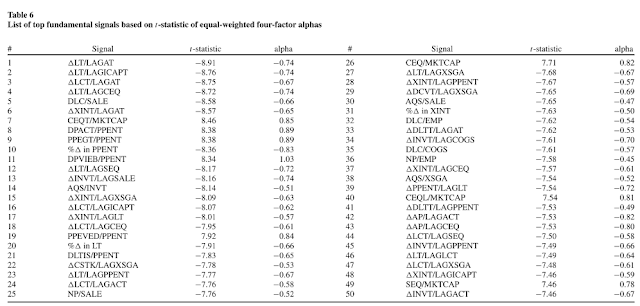
If you've read our "Seeking Advantage" paper ( available here ) you would know that Equitable Investors believes in fundamental inefficiencies in equities markets. And those views were reconfirmed by a piece of academic research that considered over 18,000 fundamental signals, concluding that: "many fundamental signals are significant predictors of cross-sectional stock returns" "This predictive ability is more pronounced following high-sentiment periods and among stocks with greater limits to arbitrage" "fundamental-based anomalies, including those newly discovered in this study, cannot be attributed to random chance, and they are better explained by mispricing" The research paper, "Fundamental Analysis and the Cross-Section of Stock Returns: A Data-Mining Approach" can be found on the University of Missouri website ( here ) or you can read a summary from CFA Institute ( here ). Consistent with our view, the research fin...

Random Reads

Warren Buffett says, “I just sit in my office and read all day.” Not everyone can afford to devote themselves to reading to that extent so here's a shortcut - the headlines that caught our eye this past week and compelled us to click and read. Greenlight Q3 '17 letter | Greenlight Capital Given the performance of certain stocks, we wonder if the market has adopted an alternative  paradigm for calculating equity value. What if equity value has nothing to do with current or future profits and instead is derived from a company’s ability to be disruptive, to provide social change, or to advance new beneficial technologies, even when doing so results in current and future economic loss? The Morningstar Mirage  | WSJ Investors everywhere think a 5-star rating from Morningstar means a mutual fund will be a top performer—it doesn’t. There’s a link between CEOs who torture the English language and poor stock performance  | MarketWatch "Academic research shows when m...

Random Reads

Warren Buffett says, “I just sit in my office and read all day.” Not everyone can afford to devote themselves to reading to that extent so here's a shortcut - the headlines that caught our eye this past week and compelled us to click and read. Mergers and acquisitions often disappoint | The Economist The study looked at M&A deals done by listed companies in America’s Russell 3000 index between January 2001 and August 2017; deals were only included if they cost more than 5% of the total enterprise value of the acquirer (5% of the equity value, for financial companies). The acquirers’ shares underperformed the market (see chart) and those of rival firms in the same industry. Vital Signs: the spooky mortgage risk signs our bankers are ignoring | The Conversation To put it in context, there appears to be in the neighbourhood of A$1 trillion of interest-only loans on the books of Australian banks. Trump and Stocks: What Gives? | Bloomberg The International Monetary...

New commentary up on livewire: An overlooked small cap agri stock

"When your competitors go one way, do you follow them, or do you go the other way?" That question was asked of a room of close to 100 financial advisers by keynote speaker Geoff Ramm at Centrepoint Alliance's annual conference last week. The focus at the time was effective marketing but resonated with this investment manager in a different context. The stocks that contributed most to the performance of the Equitable Investors' Dragonfly Fund in the month of September were clear cases of neglect. Investors, on the whole, had turned their focus elsewhere... Read the full article here .

Markets Take Time to be Efficient

Image
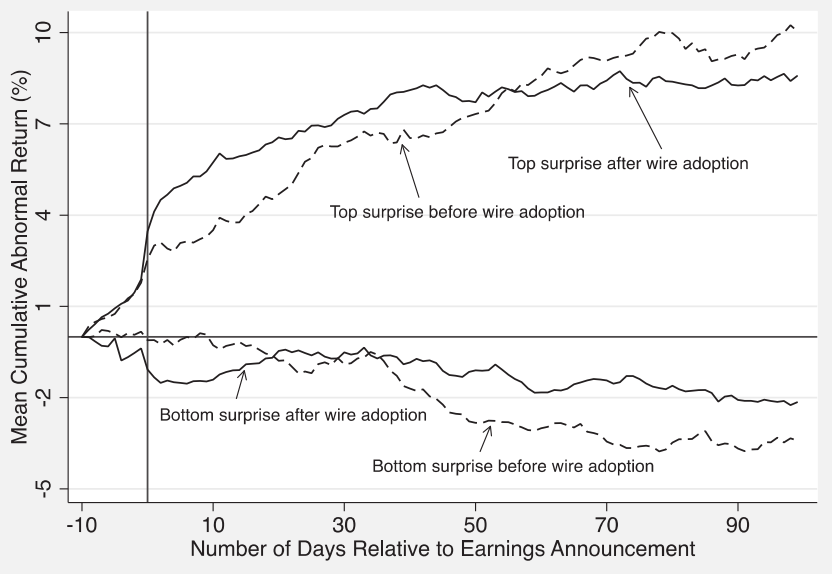
In the main we accept that markets price in known information relatively efficiently. But... information in the public domain is not always widely digested or assimilated and understood. There is evidence showing stock prices react gradually rather than instantly to new information. This is the third excerpt from a brief paper Equitable Investors put together, " Seeking Advantage -  Focusing on the Underlying Drivers of Excess Returns Most Evident in Smaller Companies to Optimise Investment Portfolios for Return and Risk ". You can read the previous excerpts at blog.equitableinvestors.com.au  a nd you can find the paper itself at   www.equitableinvestors.com.au . While information may exist in the public domain, it may not have been widely disseminated; or it may be widely disseminated but a broad base of investors may not have the additional knowledge to understand the materiality of one piece of information among many. The smaller a company is, the less likely it ...

Alignment of Interest

Image
Logic says that the managers and directors most aligned to maximising shareholder value will be those with a considerable portion of their wealth tied up in equity in the business they are involved in. This is the 2nd grab from a brief paper Equitable Investors put together, " Seeking Advantage -  Focusing on the Underlying Drivers of Excess Returns Most Evident in Smaller Companies to Optimise Investment Portfolios for Return and Risk ". You can find the first grab from that paper  here . And you can find the paper itself at   www.equitableinvestors.com.au . A recently published research paper reconfirmed historical studies that also showed managerial ownership leads to an improved performance. This January 2017 paper, Managerial Ownership, Board of Directors, Equity-based Compensation and Firm Performance: A Comparative Study Between France and the United States , by Bouras & Gallali, found that performance reached a maximum level at a managerial ownershi...

Disclaimer

Nothing in this blog constitutes investment advice - or advice in any other field. Neither the information, commentary or any opinion contained in this blog constitutes a solicitation or offer by Equitable Investors Pty Ltd (Equitable Investors) or its affiliates to buy or sell any securities or other financial instruments. Nor shall any such security be offered or sold to any person in any jurisdiction in which such offer, solicitation, purchase, or sale would be unlawful under the securities laws of such jurisdiction.

The content of this blog should not be relied upon in making investment decisions.Any decisions based on information contained on this blog are the sole responsibility of the visitor. In exchange for using this blog, the visitor agree to indemnify Equitable Investors and hold Equitable Investors, its officers, directors, employees, affiliates, agents, licensors and suppliers harmless against any and all claims, losses, liability, costs and expenses (including but not limited to legal fees) arising from your use of this blog, from your violation of these Terms or from any decisions that the visitor makes based on such information.

This blog is for information purposes only and is not intended to be relied upon as a forecast, research or investment advice. The information on this blog does not constitute a recommendation, offer or solicitation to buy or sell any securities or to adopt any investment strategy. Although this material is based upon information that Equitable Investors considers reliable and endeavours to keep current, Equitable Investors does not assure that this material is accurate, current or complete, and it should not be relied upon as such. Any opinions expressed on this blog may change as subsequent conditions vary.

Equitable Investors does not warrant, either expressly or implied, the accuracy or completeness of the information, text, graphics, links or other items contained on this blog and does not warrant that the functions contained in this blog will be uninterrupted or error-free, that defects will be corrected, or that the blog will be free of viruses or other harmful components.Equitable Investors expressly disclaims all liability for errors and omissions in the materials on this blog and for the use or interpretation by others of information contained on the blog.